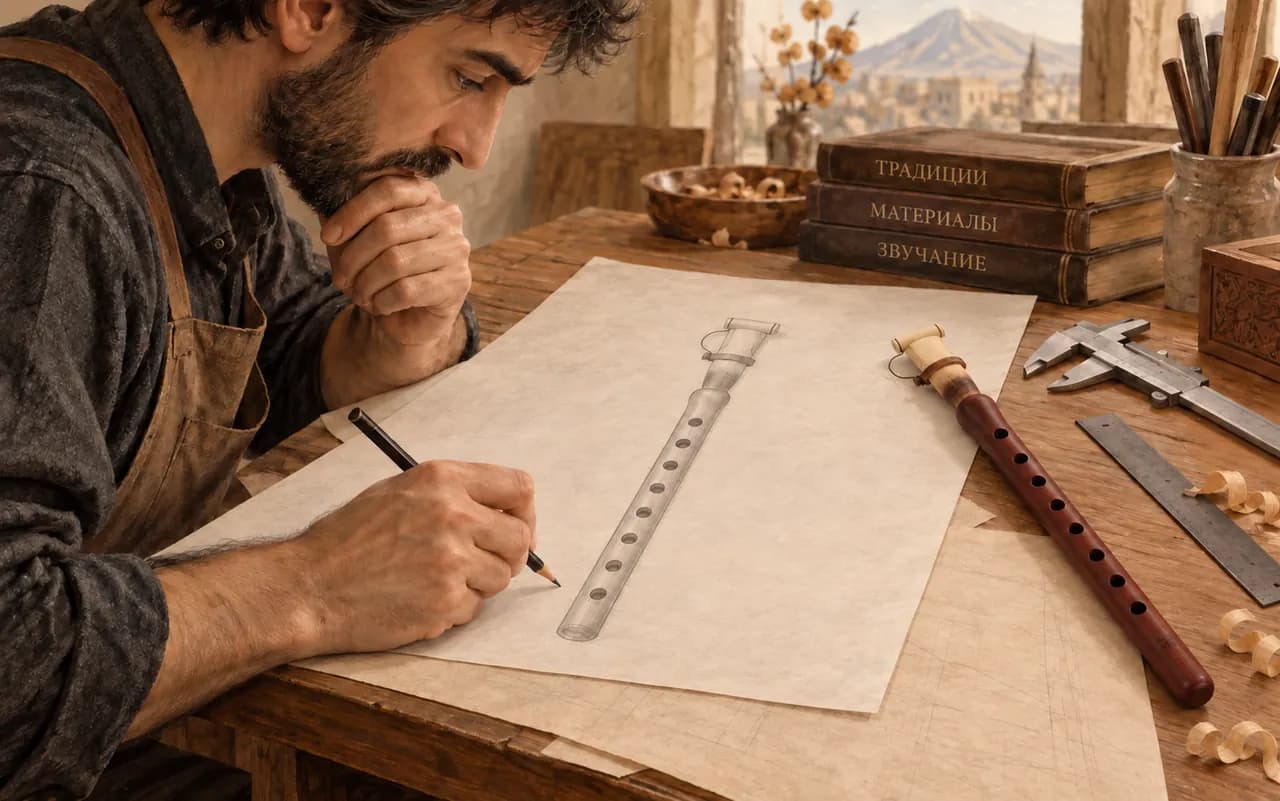
The duduk is a cylindrical type of oboe that became widespread across Armenia, Georgia and the North Caucasus. It is a cylindrical tube with 9–10 finger holes, made from apricot, dogwood, mulberry wood or walnut.
An ancient origin
The appearance of the first duduk goes back to the distant past, though there is no concrete historical evidence of its first playing. The art historian Curt Sachs calls it "a shawm or oboe of the cylindrical type with a double reed". Komitas notes that it is the "nay" — the reed in Old Persian.
Theories of origin
There are various theories about its origin.
- One of the duduk's names — "iraqya" — points to an Iranian origin.
- Another theory suggests the instrument came from the Far West via Phoenicia to the Caucasus.
- A third links it to the ancient Egyptian reed clarinet.
The name "duduk" itself derives from the articulated sounds or the words "dud" and "dod" in the Lori dialect, meaning mouth and jaw.
The development of the instrument
Until 1920 the duduk had a uniform construction. Then the duduk player Margar Margaryan gave the entry section a conical shape, making the instrument easier to tune — this became the distinguishing feature of the Armenian duduk.
The instrument's development continued thanks to outstanding musicians — Vardan Buni, Enok Kocharov and Georgy Minasyan, who created various types of low tessitura.