Like any instrument, the Armenian duduk has its own characteristics. Before beginning to play, it helps to understand the foundations of its technique and theory.
The scale
The scale has characteristics connected with the eight modes of traditional Armenian monody and their temperament. Experienced makers aim for tuning close to equal temperament to avoid false notes and excessive micro-adjustments that complicate playing. Regardless of transposition, which is closely connected with fingering, the duduk is tuned to a G Dorian scale in the system described here.
Fingering and transposition
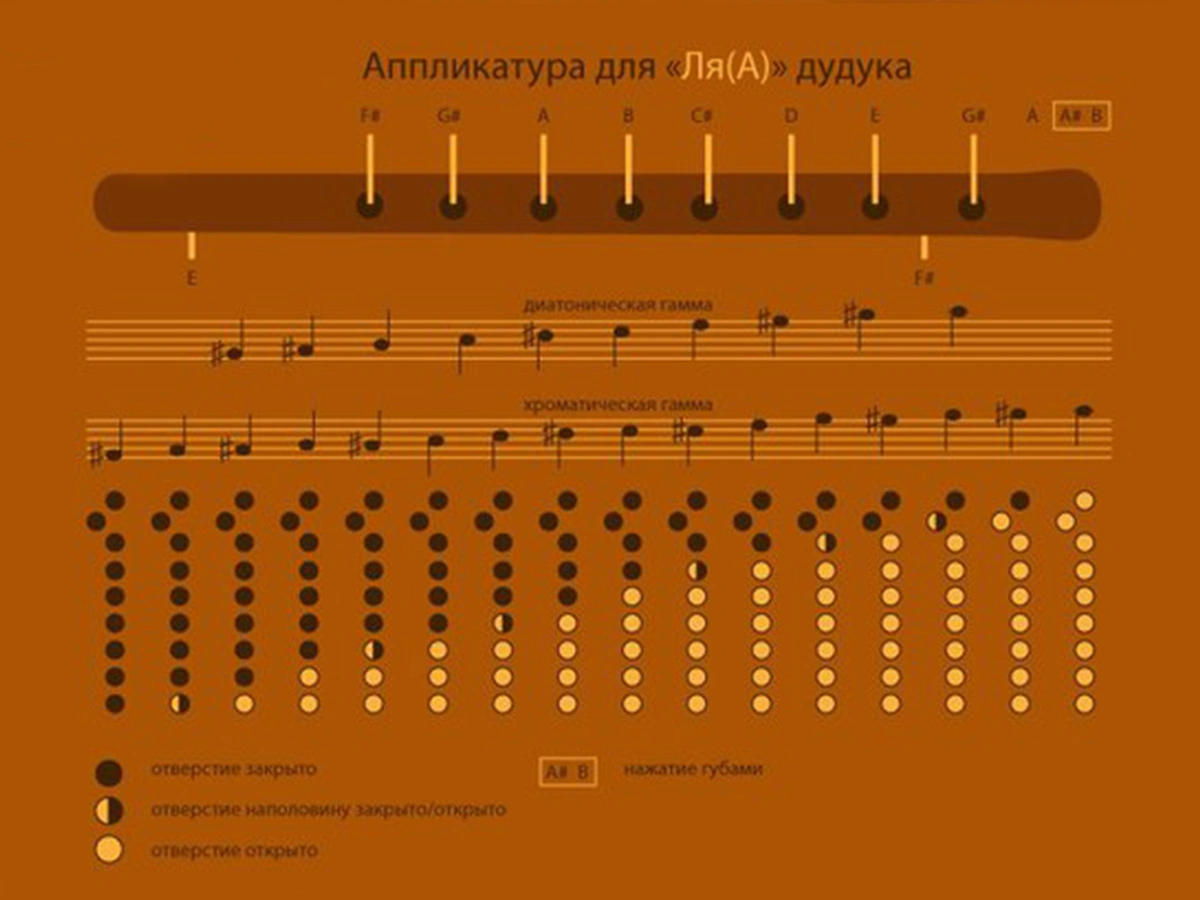
Fingering for a duduk in A. The chart is preserved from the original Dudukist article.
The second, third, fourth and fifth fingers of the right hand cover the lower four playing holes, and the corresponding fingers of the left hand cover the upper four. The right thumb supports the instrument, while the left thumb closes the upper rear hole. When necessary, the lower rear hole can be closed with a key or pressed against the chest.
Until the second half of the twentieth century there was no shared transposition system: performers usually played by ear or tried to fit every instrument to C, disrupting consistent fingering.
As duduk teaching developed, C was assigned a fixed position: six fingers close the upper six front holes and the upper rear hole is also closed, regardless of the instrument's actual sounding pitch. The resulting transposition categories were "in A", "in B", "in C", "in D" and "in F". This system became prominent in the folk music of the South Caucasus.
The traditional duduk has no playing keys, apart from keys for inaccessible holes on some modern models. The player's fingers perform this function, allowing even small fractions of a tone to be varied. This supports improvisation resembling the human voice, with micro-adjustments allowing smooth transitions between notes, including glissando.
Breathing technique
Playing requires special preparation: synchronising thoraco-abdominal breathing with the air reservoirs in the cheeks. A useful analogy is two connected atomiser bulbs: the first pumps air in pulses into the second, which remains under pressure and supplies a steady flow.
For practice, experienced performers suggest blowing through a thin straw into a glass of water. During inhalation, air from the cheeks should continue flowing into the water without interrupting the bubbles.
The original article linked this method with Ancient Egypt. The teaching sequence it described begins with breathing technique, then moves to producing and controlling sound on the mouthpiece, followed by the complete instrument.
Questions of improvement
The duduk's musical and acoustic qualities are central to its appeal. The original article criticised making instruments "by eye" and estimated that nine out of ten were unsuitable for playing. This is a claim from the historical article, not a statistic about present-day production.
Performer Margar Margaryan was among the first to address improvements to the instrument. He brought the playing holes closer together, reducing its overall size. The resulting instrument became a prototype for the soprano duduk.
In the 1920s, tar player and composer Vardan Buni developed instruments with lower transpositions. The bass modification became known as the bunifon. About half a century later, duduk players E. Kocharov and G. Minosyan continued work on improving the instrument.
The article also mentioned a craftsman from Uptsadzor who tried to extend the duduk's capabilities through a set of interchangeable attachments. According to the author, the experiment did not achieve a satisfactory sound.
Modernisation involves making an instrument using physical and mathematical calculations while preserving its essential musical characteristics.