Developing breathing technique, which involves systematic training, is of great importance in learning to play the duduk. The purity of intonation, the stability and the expressiveness of the sound all depend on how clean the breathing is.
While playing, the exhale is usually longer than the inhale and is always in an active state. The main part of the inhaled air is drawn through the mouth, and only a small part through the nose.
The preparatory stage
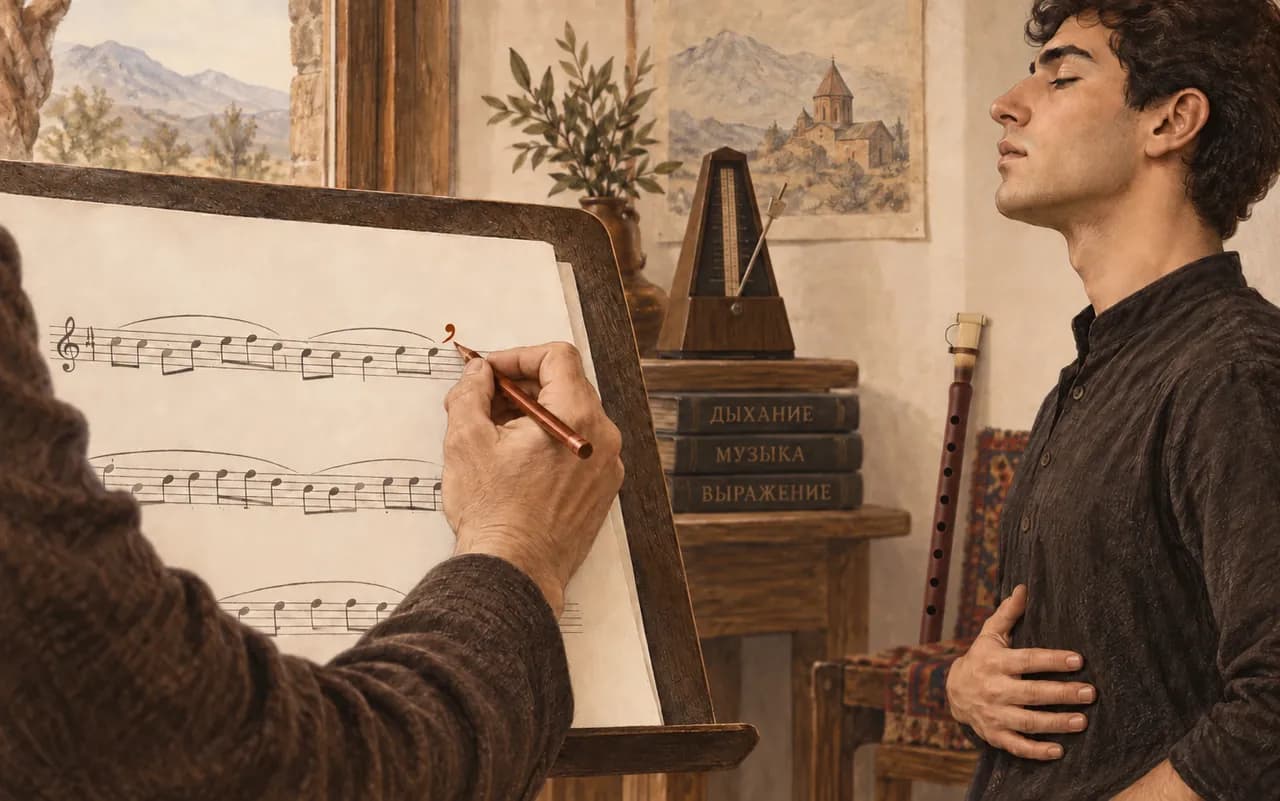
Special exercises done without the instrument play the main role in setting up correct breathing. They must not be ignored. Before producing any sounds, the duduk player must firmly learn the specifics of inhaling and exhaling. If you pick up the instrument without proper preparation, you won't be able to control the work of the lips, fingers and larynx.
In the early stages, monitoring correct breathing takes a lot of time, so these lessons are conducted strictly one-to-one.
Features of professional breathing
The performer's professional inhale is short, full and silent. It differs from a person's usual inhale in a number of ways:
- the maximum lung volume is used — about 3500–4000 ml of air (in ordinary conditions this is about 500 ml);
- the load on the muscles is many times greater than in calm breathing;
- whereas normally the inhale and exhale are roughly equal in time and a person makes 16–18 cycles, the duduk player reduces the number of breaths to 3–8 per minute;
- natural breathing goes through the nose, but when playing the duduk it goes through the mouth, with slight help from the nose. This ensures a full and silent inhale.